
Legislators receive information from many sources. Government agencies provide analysis, professional advocates present policy arguments, industry groups share research, and community organizations communicate their concerns. Among these voices, constituent perspectives have a distinctive role because elected officials represent the people living in their districts.
Grassroots lobbying creates an organized method for bringing those perspectives into the legislative process.
The Human Side of Policy
Legislation can be highly technical. Bills may contain complicated language, financial provisions, regulatory requirements, or industry-specific terminology.
Constituent stories can translate those technical questions into everyday consequences.
A local employer can explain how a proposal could affect hiring. A family can describe the impact of a program change. A community organization can explain how regulations affect services.
These examples help policymakers understand the practical side of legislative decisions.
Organizing Individual Voices
One constituent contacting a policymaker can provide valuable information. An organized network can demonstrate broader community interest.
Grassroots lobbying brings structure to that process.
An advocacy organization can identify supporters, determine their legislative districts, provide educational materials, and invite them to contact the appropriate officials.
The result is a coordinated campaign in which individual participants retain their own voices.
Quantity Is Only One Factor
Campaign managers sometimes focus heavily on contact totals.
Numbers are useful, but they should not be the only measure of success.
A large number of messages can demonstrate attention to an issue, but relevance and authenticity also matter. Policymakers need to know whether the people contacting them are constituents and why the legislation matters to those individuals.
This is why campaigns should avoid treating supporters as simple numbers.
Better Digital Advocacy
Technology has changed how organizations conduct grassroots campaigns.
Modern platforms can help identify constituents by district, create action alerts, collect participation information, and provide reporting tools.
These capabilities allow smaller teams to manage campaigns that previously required significant administrative effort.
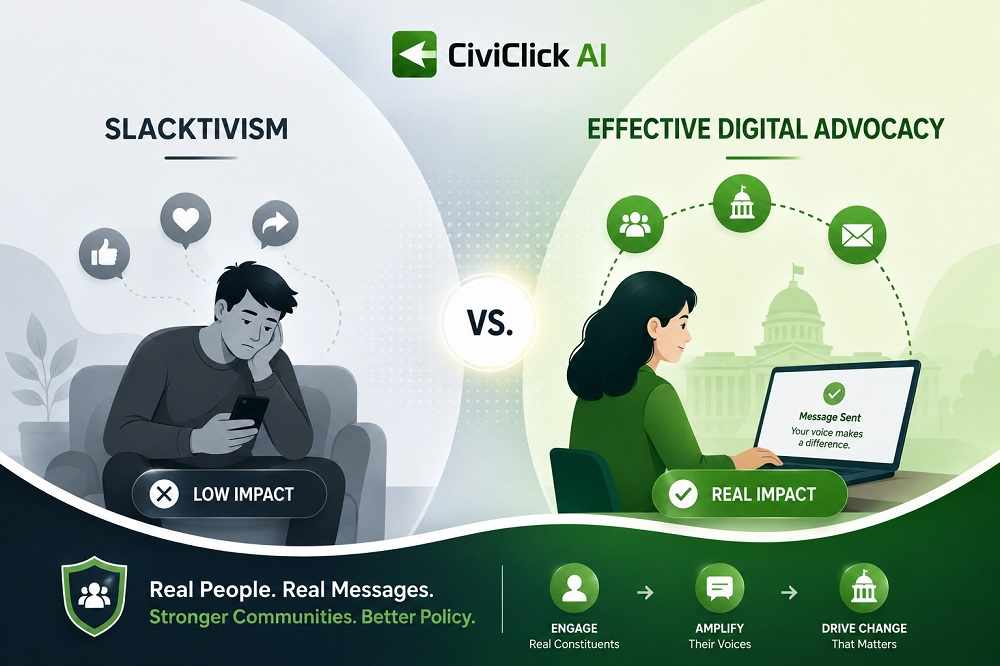
However, technology should support participation rather than replace it. The person sending the message remains the central element of a grassroots campaign.
Building Trust With Supporters
Organizations also need to consider the supporter experience.
If people repeatedly receive urgent action alerts without understanding the broader issue, they may eventually disengage.
A stronger strategy includes regular education, clear explanations, meaningful updates, and occasional opportunities for supporters to participate in different ways.
Trust grows when organizations explain what happened after an action.
If supporters contacted lawmakers before a vote, telling them whether the vote occurred and what happened demonstrates that their participation was part of a real process.
Strategic Targeting Improves Efficiency
Not every legislative office requires the same level of outreach.
Campaign teams can prioritize lawmakers based on committee assignments, voting history, district concentration, legislative authority, or the competitiveness of the issue.
They can then tailor outreach accordingly.
Some offices may need broad constituent communication, while others may benefit from a smaller number of highly relevant constituent meetings or personal calls.
Coordinating With Government Relations
Grassroots outreach is especially useful when integrated with other public affairs activities.
Government relations professionals can monitor legislative developments and communicate technical policy information. Grassroots supporters can demonstrate how those policies affect local communities.
The combination provides policymakers with both institutional knowledge and constituent perspectives.
Measure Engagement Beyond Clicks
Digital metrics such as email opens and link clicks can provide useful information, but completed advocacy actions are generally more meaningful for lobbying campaigns.
Organizations can also monitor district participation, calls, letters, meetings, volunteer activity, and policymaker responses.
Over time, these measurements can reveal which segments of the supporter base are most engaged.
Compliance Remains Essential
Organizations should understand applicable lobbying rules before launching campaigns.
Federal and state requirements can vary, and nonprofit organizations may face additional restrictions depending on their tax status and lobbying activity.
A well-managed campaign should therefore include compliance planning alongside messaging and outreach.
Creating a Stronger Public Affairs Program
Grassroots lobbying is ultimately about creating a bridge between public policy and the people affected by government decisions.
With accurate supporter data, thoughtful messaging, strategic timing, and appropriate technology, organizations can build campaigns that are organized without becoming impersonal.
Platforms such as CiviClick can help advocacy teams manage constituent actions and campaign reporting while allowing real supporters to remain at the center of the process.
When constituent engagement is treated as an ongoing relationship instead of a one-time transaction, organizations can build stronger advocacy programs and create more meaningful opportunities for people to participate in public policy.





Write a comment ...